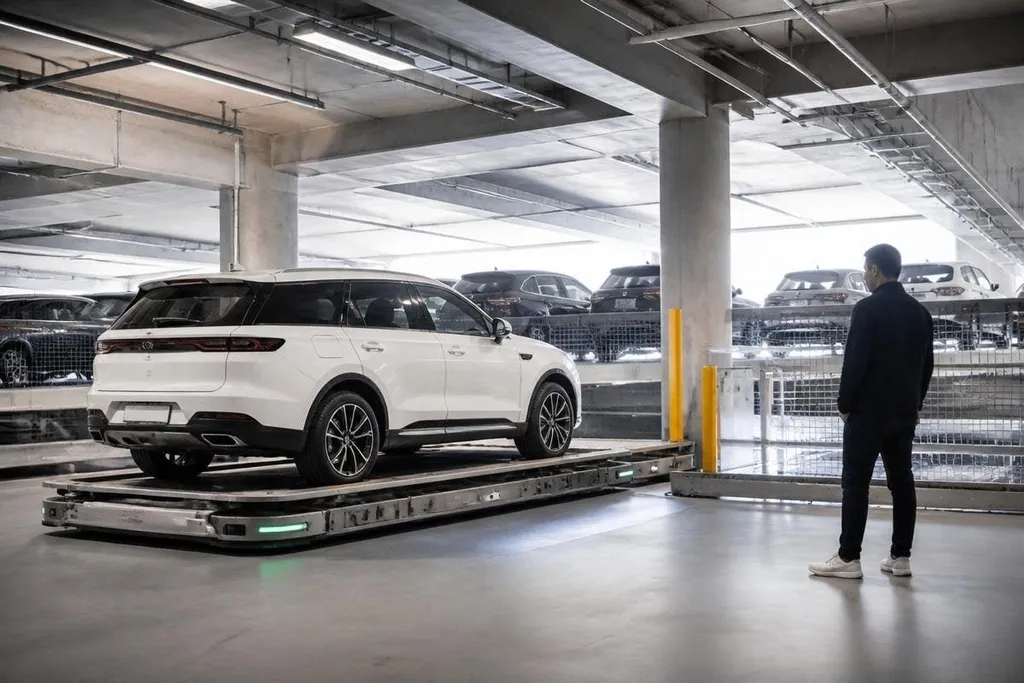
A parking robot has to do more than move a car from one space to another. It must read a changing garage, choose a safe route, handle people and vehicles, and return the right car when asked.
Quick read
- Cameras, LiDAR, and software help the robot read its surroundings.
- AI can adjust routes when a lane, ramp, or parking space changes.
- Human checks, clear garage rules, and safe fallback modes still matter.
From fixed paths to live decisions
Older automated parking systems can depend on marked lanes, fixed parking bays, or guide rails. Those systems work well when the site stays close to its planned layout, but a parked car, closed lane, or person in the wrong place can break the plan.
AI changes the task by helping the robot build a fresh view of the garage. Cameras can identify cars, people, signs, and open areas. LiDAR measures distance with light pulses, giving the robot a three-dimensional view of walls, vehicles, and ramps. Software combines those inputs into a map it can use while moving.
The useful change is continuous adjustment. If another vehicle blocks a route, the robot can slow down, stop, and select another path when its software supports that function. The system still needs rules for safe movement, because a fast decision is not a safe decision by itself.
Parking is a perception problem
A parking robot needs to know where it is before it can place a vehicle accurately. This process, called localization, compares sensor readings with a map or with visible features in the garage.
Paint lines may be hard to see in low light. Concrete pillars can look alike. Reflections from cars and glass can confuse cameras. A garage may also change after construction work, new signs, temporary barriers, or a different arrangement of vehicles.
AI models can help classify these details, but they still depend on useful sensor data and careful system design. A camera cannot recover information that darkness, glare, dirt, or an obstructed view has removed. For that reason, parking robots often need several sensor types working together rather than one software model doing everything.
The handoff to drivers starts with evidence from the garage, not the software menu. Robot24.com can point you to parking-robot reports with the site, lighting, sensor setup, test date, and measured result, so you can judge the driver-facing software that follows.
Where the software helps drivers
The customer may see a simple service: leave the car at a handover point, then collect it later. Behind that step, the system has to record the vehicle location, match the car to the right request, assign a parking space, and send movement instructions to the robot.
AI can help with space selection when the garage has different vehicle sizes or changing demand. A small car may fit in a tighter space than a large vehicle, while an electric vehicle may need access to a charging point. The software can use those details when the garage system provides them.
The same information can help staff find faults. If a robot stops near a blocked lane, the control system can show its location and the event that caused the stop. That gives an operator a place to start instead of asking them to search the whole garage.
The limits are physical
AI cannot fix a garage with poor markings, weak lighting, unreliable communications, or unsafe pedestrian access. A robot may also need a human operator when a sensor becomes dirty, a vehicle is parked outside its bay, or an object appears that the system was not prepared to handle.
Security brings another concern. The system handles vehicle identity, location data, and access requests. Operators need rules for who can view that data and who can release a vehicle. A parking robot that moves correctly but exposes customer information still creates a serious business problem.
The strongest claims should also be tested against the site itself. A controlled demonstration may show a clear route and predictable traffic. A busy garage adds mixed vehicle sizes, people walking between cars, delivery activity, and emergency stops. Those conditions decide how much AI helps in daily use.
A practical buying checklist
Use these questions before choosing an AI-based parking robot system:
- Ask which sensors the robot uses and how it handles blocked or dirty sensors.
- Check the fallback mode when the network, map, or robot control system fails.
- Confirm how the system identifies vehicles and protects location records.
- Test a route with pedestrians, temporary barriers, ramps, and poor lighting.
- Define who can stop a robot and who can release a vehicle after a fault.
I'd skip any system whose AI claims cannot be tied to a clear safety process and a site test.
The next useful measure is not how smoothly a demo runs. It is how often the robot stops, why it stops, and how long staff take to restore service in the garage you plan to use.